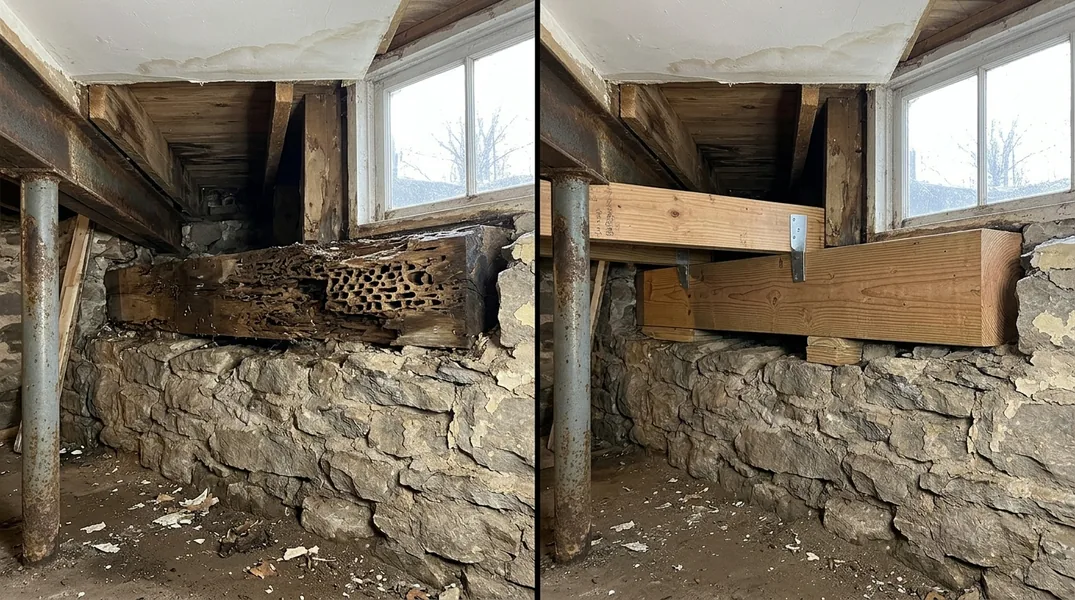
Why is My Floor Sagging? Common Causes in Older Syracuse Homes
If you own an older home in Syracuse, you've probably noticed the telltale signs: floors that slope gently toward the center of the house, creaking underfoot, or doors that won't close properly. A sagging floor isn't just an aesthetic complaint or a minor inconvenience. It's a structural warning sign that something underneath needs attention.
The most common culprit behind sagging floors in older Syracuse homes is moisture damage to the foundation support system. Many of these homes were built on stone foundations with damp basements, a combination that creates the perfect environment for wood rot. When moisture migrates upward through the stone and into the wooden sill plates and floor joists that sit on top of the foundation, the wood begins to deteriorate. Rot weakens the structural integrity of these critical support members, causing them to sag under the weight of the house above.
Beyond moisture, you might also be dealing with Termite Damage Repair or simply the natural settling and wear that comes with a house that's been standing for 80, 100, or even 150 years. But in our region, dampness is almost always the underlying issue.
Damp Stone Basements and Rotted Sill Plates: The Root Problem
Stone basements are charming and historic, but they're also notoriously damp. Stone is porous and absorbs moisture from the surrounding soil, especially in areas like Syracuse where freeze-thaw cycles and heavy spring runoff are common. When water wicks up through the stone foundation, it reaches the wooden sill plate, which is the board that sits directly on top of the foundation and supports the entire first floor frame.
The sill plate is often the first casualty of foundation moisture. It's in constant contact with the damp stone, and unlike other parts of your home's frame, it's difficult to dry out or treat. Over time, the wood fibers soften and break down. Wood Rot & Dry Rot Repair becomes necessary, but many homeowners don't realize the problem exists until the floor above has already begun to sag noticeably.
The damage doesn't stop at the sill plate. Once the sill is compromised, moisture travels into the floor joists that rest on or near it. These joists, which run perpendicular to the sill and carry the load of the floor system, begin to rot from the bottom up. As they weaken, they can no longer support their share of the load, and the floor deflects downward.
Floor Joist Repair and Sistering Floor Joists: Real Solutions
Floor Joist & Subfloor Repair is one of the most common structural repairs we perform in older homes. When joists are damaged by rot or age, the standard solution is a technique called sistering, which involves fastening a new, pressure-treated beam alongside the damaged joist to share the load. This reinforces the floor and stops the sagging.
Sistering floor joists is a proven method that works well when the rot hasn't completely destroyed the existing joist. A new sister beam, typically made from pressure-treated lumber of the same dimensions as the original, is carefully fitted and bolted or screwed to the damaged joist along its entire length. This effectively doubles the load-carrying capacity of that section of the floor. In many cases, homeowners are amazed at how quickly the floor stiffens and the sag is eliminated.
However, sistering isn't always the complete answer. If the sill plate itself is severely rotted, or if multiple joists are affected, a more comprehensive repair may be necessary. This is where professional assessment becomes critical. A thorough inspection will reveal the full extent of the damage and determine whether sistering alone will solve the problem or whether Beam Replacement & Load-Bearing Wall Removal work is also needed.
Sill Plate Replacement: When Sistering Isn't Enough
In some cases, the sill plate damage is so extensive that it must be removed and replaced entirely. Sill plate replacement is a more involved project than sistering, but it's essential when the foundation support is compromised. The process involves carefully jacking up the house section by section, removing the rotted sill plate, installing a moisture barrier, and setting a new pressure-treated sill in its place.
This is not a DIY project. It requires temporary support posts, precise jacking procedures, and careful coordination to ensure the house remains stable throughout the work. It also typically requires a building permit and professional engineering oversight, depending on your local code requirements. The investment is significant, but replacing a rotted sill plate addresses the root cause of the sagging and prevents future damage.
After the sill plate is replaced, attention turns to the floor joists. Some may be salvageable with sistering, while others may need partial or complete replacement. The goal is to restore the structural integrity of the entire floor system so that it will support the house safely for decades to come.
Addressing the Moisture Problem: Basement Waterproofing and Ventilation
Repairing the rotted wood is only half the battle. If you don't address the moisture problem, the new wood will eventually rot too. This is why any serious floor repair must include a strategy to manage basement dampness. Interior sump pumps, exterior foundation drains, and improved grading around the foundation can all help keep water out of the basement.
Ventilation is another key piece of the puzzle. Many older basements lack adequate air circulation, which allows humidity to build up and keep wood permanently damp. Installing a dehumidifier or improving ventilation with a small exhaust fan can make a dramatic difference. Some homeowners also benefit from a vapor barrier on the basement floor or walls, which slows moisture migration into the space above.
These moisture management steps are preventive. They won't undo existing rot, but they will protect your repair investment and prevent future damage to the floor system.
Sagging Floor Repair Cost in Syracuse: What to Budget
The pricing for sagging floor repair varies widely depending on the scope of damage and the solution required. Sistering a few joists might cost anywhere from a few thousand dollars to several thousand, depending on how many joists need reinforcement and how accessible they are. A full sill plate replacement, which involves temporary support and more labor, typically costs more and may require additional structural work.
The best way to understand what your repair will cost is to schedule a professional inspection. The team at Syracuse Carpentry can assess your specific situation, identify all the damage, and provide you with a clear estimate. During the inspection, we'll also identify any moisture issues that need to be addressed to prevent future problems. Contact us at (315) 883-2768 or fill out our free estimate form to get started.
While the cost of repair can feel daunting, remember that addressing sagging floors promptly is far less expensive than waiting until the structural damage becomes severe. Early intervention can mean the difference between a focused repair and a major reconstruction.
When to Call a Professional for Floor Repair Near Me
If you notice your floors are sagging, bouncy, or sloping, don't wait. The longer you delay, the more damage occurs and the more expensive the repair becomes. A professional inspection is the first step, and it's the only way to know for certain what you're dealing with.
Syracuse Carpentry has years of experience repairing sagging floors in older homes throughout the region. We understand the unique challenges posed by our climate, our stone foundations, and our aging housing stock. We can help you understand what's wrong, what your options are, and what a realistic repair plan looks like. Call us today at (315) 883-2768 to schedule your free estimate, and let's get your floors level again.
Looking for a professional carpentry contractor in Syracuse? Syracuse Carpentry responds fast for all your carpentry needs.
Get a Free QuoteOur services: Wood Rot & Dry Rot Repair · Termite Damage Repair · Floor Joist & Subfloor Repair