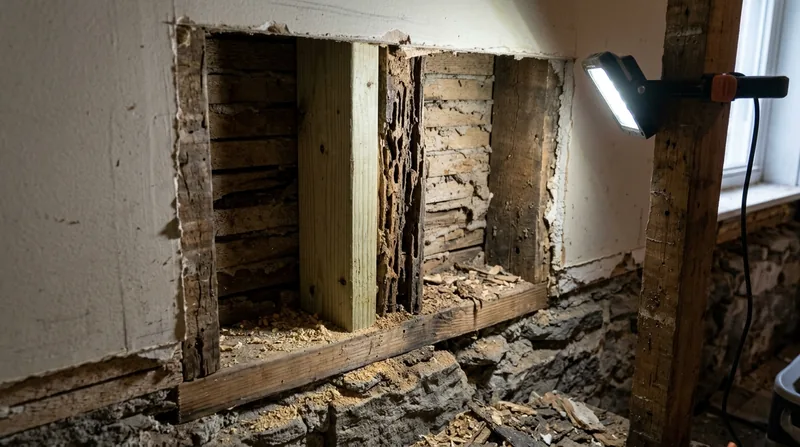




Syracuse's oldest neighborhoods, the Victorian Queen Annes and Italianates of the Near Westside, the Arts and Crafts homes on Sedgwick Farm, the stacked-porch flats of Westcott and Eastwood, sit on limestone rubble foundations with damp basements and wood sills close to grade. Lake-effect snow, freeze-thaw winters, and humid summers keep these sills and porch posts perpetually damp. Carpenter ants are the dominant wood-eating pest here, but subterranean termites show up now and then and do the same damage: they hollow out studs, sills, trim, and subfloor sections until the wood loses structural integrity. Once your pest control contractor has treated the infestation, the damaged wood remains and must be repaired or replaced. Termite damage repair in Syracuse means replacing that hollowed wood with new material and restoring full structural integrity. We work from your pest inspection report and replace only what the damage demands, keeping costs realistic and the repair honest.
Why Termite Damage Repair Matters in Syracuse's Older Homes
Subterranean termites work silently inside the wood, leaving the surface intact while hollowing the interior. By the time a pest inspector finds them, the damage is often extensive: studs become spongy, sills lose bearing capacity, and subfloor sections bow under load. Unlike carpenter ants, which leave visible sawdust and galleries, termites can go undetected for years in a damp Syracuse basement or crawlspace. Once the pest treatment is complete, the structural repair cannot wait. Delaying wood replacement allows the remaining sound wood to continue settling, creating floor sag, wall misalignment, and cracking plaster.
- We remove and replace hollowed studs, sills, rim joists, and subfloor sections based on your pest inspection report.
- We restore full bearing capacity by sistering new framing members or replacing sections outright, depending on what the damage shows.
- We match existing materials where finish or historical character matters, and use pressure-treated lumber for sills and rim joists in damp basements.
- We document all work for insurance claims, photographing before, during, and after conditions.
Addressing termite damage promptly prevents secondary failures like sagging floors, cracked ceilings, and structural misalignment that cost far more to repair later.
Key info: Termites in Syracuse are most active in spring and early summer when soil temperatures rise and swarming occurs. If you see mud tubes on your basement walls or sills, or if a pest inspector confirms an infestation, act quickly. The longer termites feed, the more extensive the wood replacement becomes. We can start work within days of pest treatment completion.
For more information on wood damage assessment and repair philosophy, see our wood rot and dry rot repair page, where similar structural pathologies are explained in detail.
How We Repair Termite Damage: Our Process in Syracuse
Termite damage repair begins with a clear inspection of what the pest report identified and what we can see when we probe the wood. We determine whether a member can be sistered (reinforced with new lumber fastened alongside), partially replaced (a section cut out and new wood spliced in), or fully replaced. Sills and rim joists in damp basements almost always require full replacement because they bear vertical load and sit in the zone where moisture is highest. Studs and subfloor sections can often be repaired with a combination of removal and splicing, saving cost without compromising strength.
- We obtain a copy of the pest inspection report and mark all damage zones on-site.
- We probe suspect wood with a awl and knife to map the extent of hollow areas and sound wood.
- We remove damaged sections using hand tools and reciprocating saws, working carefully to avoid disturbing adjacent framing or finishes.
- We install new material using fasteners and adhesives rated for the wood species and load conditions.
- We restore trim, casing, or baseboard to match the existing finish where the repair is visible.
- We take photographs of the damage before removal and of the completed repair for your records and insurance documentation.
The entire process is transparent, and we explain what we find and why each repair method is the right choice for that location and load.
Local example: A 1910 Colonial Revival home in Eastwood had termite damage in the rim joist and two floor joists under the kitchen. The homeowner's pest inspector found mud tubes and treated the infestation. We removed the damaged rim joist section, installed new pressure-treated lumber with proper bearing on the foundation, and replaced the two compromised joists. The floor became level again, and the kitchen cabinets sat true. Total repair time was three days, and the cost was well below what a full subfloor replacement would have been.
For more on structural framing and joist replacement, visit our floor joist and subfloor repair page.
Termite Damage Repair Methods: Repair vs. Replace
| Approach | Description | Best for |
|---|---|---|
| Sistering | A new framing member is fastened alongside the damaged one, sharing the load and restoring strength without removing the original. | Studs with partial termite damage, joists where removal would disturb finishes, or where historical preservation is a priority. |
| Partial replacement (splicing) | The damaged section is cut out and a new piece spliced in using fasteners and adhesive, with the joints staggered for strength. | Sills with damage at one end, rim joists where only a corner section is affected, or trim and casing where appearance matters. |
| Full replacement | The entire damaged member is removed and a new one installed, using the same species and grade where possible. | Sills and rim joists in damp basements, joists where termite damage is extensive, or where code or load conditions demand new material throughout. |
| Temporary support and shoring | Posts, beams, or adjustable shores hold the floor or wall during removal and replacement, ensuring no settlement or cracking occurs. | Any repair in a load-bearing area, especially where damage affects multiple joists or where the floor is already sagging. |
The method we choose depends on the location, extent of damage, and whether historical character or cost is the priority. We always aim to repair rather than replace when the remaining wood is sound and the repair meets code.
Termite Damage Repair Cost in Syracuse: What to Expect
Termite damage repair costs in Syracuse start at around $1,200 for a localized repair (a single rim joist section or two floor joists) and scale up based on how much wood must be replaced. A full sill replacement under a 40-foot wall section can run $3,500 to $6,000. Extensive damage affecting multiple joists, the subfloor, and studs in a large area can exceed $10,000. The main factors that move the cost are the linear footage of sill or rim joist needing replacement, the number of joists affected, whether the repair is in a basement or crawlspace (which adds access difficulty), and whether existing finishes must be removed and restored afterward.
Getting two or three estimates from local carpenters is smart. Each contractor will assess the damage differently depending on how conservatively they repair and what materials they specify. Some will sissy a joist where others would replace it; some will use standard lumber where pressure-treated makes sense. A detailed estimate should explain what's being removed, what's being installed, and why. Our free estimate includes a written scope and price, and we respond within 24 hours at (315) 883-2768.
For a full pricing overview and what factors affect your specific job, visit our pricing page.
Termite Damage Repair Near Me: What Syracuse Homeowners Should Know When Hiring a Contractor
Hiring a carpenter to repair termite damage is a structural decision, not a cosmetic one. The contractor you choose must understand load-bearing principles, know how to work safely around existing framing, and be willing to document the damage and repair for your insurance claim. Start by asking whether the contractor is fully insured and can provide a certificate of insurance. Ask for references from recent termite damage repairs in Syracuse, Camillus, or Liverpool. Call those references and ask whether the floor became level again, whether the work was completed on time, and whether the contractor explained the repair choices clearly.
Check whether the contractor understands local building codes and when a permit is required. Structural repairs often trigger a permit threshold, and your local building department can tell you what applies to your job. If the damage is near a protected tree or in a historic district, ask whether the contractor has experience with those constraints. Some repairs in older homes require careful coordination with the city's historic preservation office or a homeowners association. A good contractor will know these rules and factor them into the estimate.
- Ask for proof of full insurance coverage and request a certificate naming your address as additional insured.
- Request references from at least two termite damage repairs completed in the past two years in Syracuse or a nearby suburb.
- Confirm that the estimate includes a written scope describing what wood is being removed, what's being installed, and what the repair cost covers.
- Verify that the contractor is willing to take photographs before and after for your insurance documentation.
- Ask whether the contractor has experience with the specific failure (sill rot, joist damage, subfloor) and can explain the repair method in plain language.
A contractor who rushes the estimate, avoids your questions, or won't provide references is a red flag. Take your time, compare prices and approaches, and choose someone you trust to do the work right the first time.
Ready to move forward? Contact us for a free, no-obligation estimate, or call (315) 883-2768 to discuss your termite damage repair.
Termite Damage Repair in Syracuse: Pricing Guide
| Service | Price | Details |
|---|---|---|
| Single joist or rim joist section repair | Starting at $1,200 | Includes removal, replacement lumber, fastening, and finishing. Typical for localized termite damage affecting one or two members in accessible locations. |
| Sill plate or rim joist replacement | Starting at $2,800 | Full or partial sill replacement under load-bearing walls, including temporary shoring, pressure-treated lumber, and restoration of finishes or trim. |
| Multi-joist or subfloor damage | Starting at $5,200 | Extensive repairs affecting multiple floor joists and subfloor sections, including removal, sistering or replacement, and restoration of floor level and finishes. |
| Comprehensive termite damage assessment and repair | On estimate | Large-scale damage across multiple structural zones requires on-site inspection to determine scope, access constraints, and whether partial or full replacement is warranted. |
| Travel and site visits | Included | No separate mileage or travel fee within Syracuse and surrounding areas. Estimate response within 24 hours at (315) 883-2768. |
| Free estimate | Free | Written scope and price with no obligation to book. We explain repair options and answer all questions before you decide. |
Indicative pricing, the exact cost depends on square footage, finish, and site access. Free personalized estimate within 24h at (315) 883-2768.


